Einsamkeit auf Rezept: Wie deutsche Städte gegen die stille Epidemie vorgehen
Was tun gegen ein Gesundheitsproblem, das keine Tablette lösen kann? In mehreren deutschen Städten setzt man inzwischen auf einen ungewöhnlichen Ansatz: Statt Medikamenten verschreiben Ärzt:innen und Gesundheitsämter soziale Aktivitäten – von Tanzkursen bis Fotografie.
Das Ausmaß des Problems Laut Daten der Weltgesundheitsorganisation (WHO) aus dem Jahr 2025 ist weltweit jeder sechste Mensch von Einsamkeit betroffen. Besonders seit der Corona-Pandemie berichten viele Menschen, dass es schwerer geworden ist, Kontakte zu knüpfen und zu halten – Homeoffice, städtischer Stress und der Wegfall fester Alltagsstrukturen spielen dabei eine Rolle.
Wie „Social Prescribing“ funktioniert In Frankfurt läuft seit einiger Zeit das Projekt „Social Prescribing – Rezepte gegen Einsamkeit“ über das städtische Gesundheitsamt. Interessierte melden sich, füllen einen Fragebogen aus und werden nach einem Kennenlerngespräch an ein passendes, meist kostenfreies Angebot vermittelt – etwa Tanz-, Foto- oder Schreibkurse.
Hannover geht seit September 2025 einen ähnlichen Weg, allerdings direkt über Hausarztpraxen: Rund 60 Praxen beteiligen sich an dem Programm, das gezielt ältere Menschen anspricht. Die Idee dahinter: Hausärzt:innen erkennen körperliche wie seelische Symptome oft als erste und können frühzeitig auf soziale Angebote in der Nachbarschaft verweisen.
Parallel dazu läuft ein größeres europäisches Forschungsprojekt zu „sozialen Rezepten“ in Praxen in Freiburg, Berlin und Hamburg, das von der Charité wissenschaftlich begleitet wird. Ursprünglich stammt die Idee aus Großbritannien, wo „Social Prescribing“ bereits seit einigen Jahren fester Bestandteil der Gesundheitsversorgung ist.
Funktioniert das wirklich? Erste Machbarkeits-Studien deuten auf spürbare positive Effekte hin: weniger Einsamkeitssymptome, ein verbessertes Wohlbefinden und eine höhere empfundene Lebensqualität bei den Teilnehmenden. Die Stadt Hannover bewertet ihr Programm bereits jetzt als Erfolg.
Warum das mehr ist als ein Wohlfühlthema Die gesundheitlichen Folgen von Einsamkeit sind gut belegt: Studien zeigen einen deutlichen Zusammenhang mit Herz-Kreislauf-Erkrankungen, Schlaganfällen, Diabetes sowie Depressionen und Angststörungen. Einsamkeit ist damit kein rein emotionales Thema, sondern ein handfester Risikofaktor für die körperliche Gesundheit.
Was das für uns bedeutet Was hier auf kommunaler und medizinischer Ebene gerade erprobt wird, bestätigt etwas, das wir bei TRIO täglich beobachten: Bewegung und Gemeinschaft sind kein „Nice-to-have“ – sie sind ein messbarer Gesundheitsfaktor. Genau deshalb bauen wir Programme wie Walk & Talks oder Buddy Matching direkt dort, wo Menschen ohnehin regelmäßig hinkommen: im Fitnessstudio.
Most gyms don’t have a leads problem they have a conversion and retention problem. There’s usually enough interest walking past the door or scrolling past the Instagram page; the real gap is turning that interest into paying members who stick around. Here’s a grounded, practical playbook for closing that gap.
1. Get Precise About Who You’re Actually Serving
„Everyone who wants to get fit“ isn’t a target market it’s a reason your marketing feels generic. The gyms that grow fastest usually own a specific identity: the busy professional squeezing in a 45-minute session, the postpartum mom rebuilding strength, the 50+ crowd prioritizing longevity, the beginner who’s intimidated by traditional gym culture.
Pick your person. Every headline, class name, and Instagram caption should sound like it was written for them, not for a general audience. Specificity doesn’t shrink your market it makes the right people feel instantly understood, which is what actually drives sign-ups.
2. Make the First Visit Nearly Risk-Free
The biggest barrier to a new client isn’t price, it’s uncertainty. People don’t know if they’ll fit in, if the workout is too hard, or if they’ll feel judged. Lower that barrier aggressively:
A free trial class or week, not just a tour
A „beginner-friendly“ tag on specific classes so newcomers know exactly where to start
A short intro call or welcome message before their first visit, so a real person greets them by name
The goal is to make walking through the door feel like the easy, obvious next step not a leap of faith.
3. Turn Current Members Into Your Marketing Team
Referral programs outperform paid ads for most local gyms, because trust travels faster through a friend than through a Facebook ad. A referral program works best when it’s simple and mutually rewarding for example, both the referrer and the new member get a free class or a month’s discount.
Beyond formal referral programs, give members things worth sharing: a genuinely good workout, a milestone board, a photo moment after a hard class. People post what makes them feel proud, and their friends notice.
4. Build Local Visibility Before Digital Visibility
Before scaling ad spend, make sure the fundamentals of local discovery are airtight:
A complete, accurate Google Business Profile with real photos and regularly updated posts
Consistent replies to reviews, especially critical ones how you respond says more than the review itself
Partnerships with nearby businesses (physiotherapists, nutritionists, cafes) for cross-promotion
Community presence sponsoring a local event, hosting a free open house, showing up where your target member already spends time
Local SEO and community visibility are slower than paid ads, but they compound and don’t disappear the moment you stop spending.
5. Use Content That Shows, Not Just Tells
Generic motivational quotes don’t convert. What does: short videos of real classes in progress, member transition stories (with permission), a coach explaining why a particular program works, behind-the-scenes glimpses of what a first class actually feels like.
Prospective members are trying to answer one question before they ever walk in: „Will I belong here?“ Content that answers that honestly showing real people, real energy, real coaching style, does more work than any discount ever will.
6. Fix the Leaky Bucket: Retention Is Client Acquisition in Disguise
Every client who leaves after month two is a client you have to re-acquire from scratch. Before pouring more budget into new leads, look hard at your retention data. Common fixes that move the needle:
A structured onboarding path for the first 30 days (not just a single intro session)
Regular, personal check-ins, a coach noticing an absence and reaching out beats any automated email
Community touchpoints beyond the workout itself, so members build relationships that keep them coming back even on low-motivation days
Clear progress markers, so members can see they’re improving, not just hope they are
A gym that keeps 80% of new members past month three needs far fewer new leads to hit the same growth number as one that keeps 50%.
7. Price for Commitment, Not Just for Access
Membership structures that reward consistency give members a reason to stay engaged beyond willpower alone. Price isn’t just a number; it’s a signal about what you value, and structuring it around commitment (rather than pure access) reinforces the behavior you actually want.
8. Track the Few Numbers That Actually Matter
You don’t need a dashboard with fifty metrics. Track:
Trial-to-paid conversion rate
90-day retention rate
Referral rate (percentage of new members who came from an existing member)
Cost per acquired client, by channel
These four numbers will tell you, with real clarity, whether your growth problem is at the top of the funnel (not enough interest) or further down (interest that isn’t converting or sticking). Most gyms are surprised to learn it’s the latter.
9. Rethink What „Growth“ Actually Means
Here’s the shift worth sitting with: you don’t actually need more clients to grow. You need the clients you already have to stay longer, show up more often, and trust you with more of their wellbeing over time.
Run the math on your own numbers and this stops being a nice sentiment and starts being a strategy. A member who stays five years and gradually adds a nutrition consult, a recovery session, or a small-group program is worth several times more than three members who churn out after two months each and costs a fraction as much to keep, since no acquisition spend is required to retain someone who already trusts you. Constant new-client growth is expensive, unpredictable, and it never lets up. A strong, engaged community compounds quietly in the background instead.
This is why community is not a „nice to have“ sitting next to the real business it is the retention engine, and retention is the real growth engine. A gym where members know each other’s names, celebrate each other’s milestones, and feel like they’d be missed if they stopped showing up doesn’t need to chase growth nearly as hard, because people don’t leave communities the way they leave transactions. They leave when nobody would notice so make sure someone always would.
That’s the real long game: fewer people walking out the back door, each one staying longer, engaging more deeply, and spending more over time because the relationship is worth more to them than the workout alone. Get the community right, and sustainable growth becomes a natural byproduct not something you have to force.
Wir glauben: Wirkliche Gesundheit entsteht dann, wenn körperliches Training und mentale Stärke zusammenkommen. Genau diese Kombination möchten wir mit TRIO neu denken.
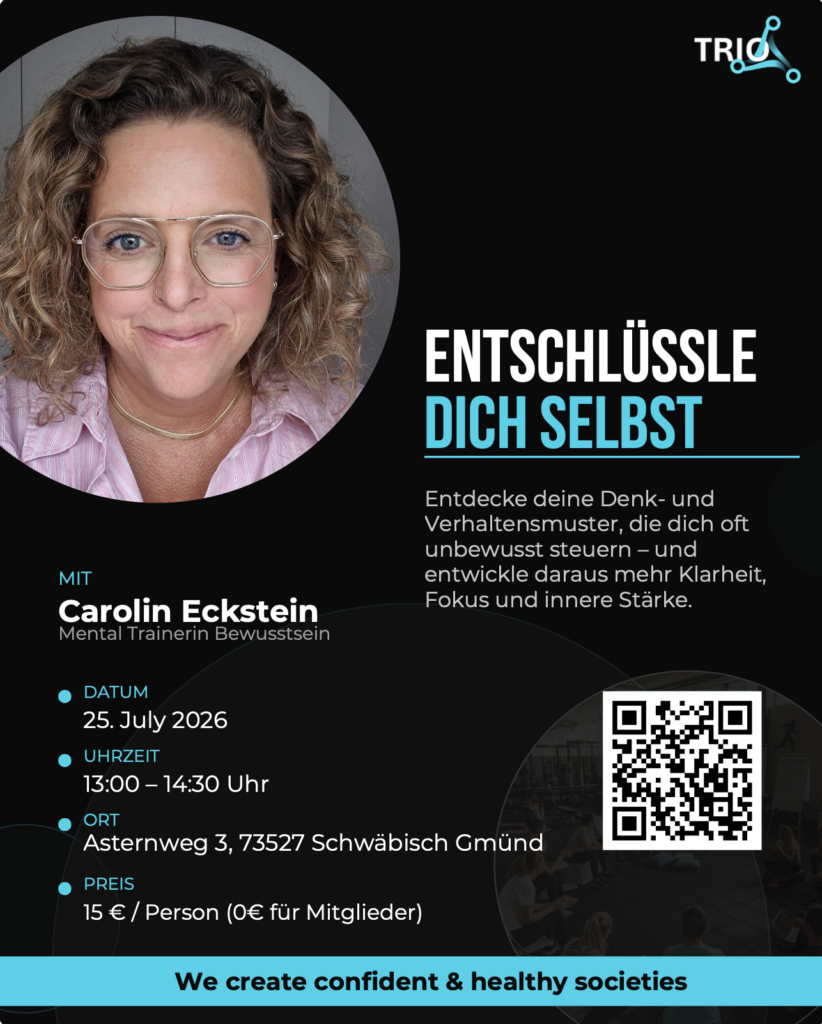
Deshalb veranstalten wir gemeinsam mit der Mentaltrainerin Carolin Eckstein unseren ersten Test-Workshop direkt innerhalb eines Fitnessstudios:
In diesem Workshop geht es darum, die eigenen Denk- und Verhaltensmuster besser zu verstehen, also die Dinge, die uns im Alltag oft unbewusst steuern.
Denn mentale Gesundheit gehört für uns genauso zu einem gesunden Lebensstil wie Bewegung, Training und körperliches Wohlbefinden.
Was dich erwartet: – mentale Klarheit & Fokus – mehr Bewusstsein für eigene Muster – ehrlicher Austausch – neue Perspektiven für persönliche Entwicklung – die Verbindung von Fitness & Mental Wellbeing
Mit diesem ersten Event testen wir bewusst ein neues Konzept: Die Kombination aus Gym-Community, persönlicher Entwicklung und Mental Health in einem gemeinsamen Raum.
Wir freuen uns riesig auf Feedback, Austausch und einen inspirierenden Nachmittag mit euch. 💫
Um dir ein optimales Erlebnis zu bieten, verwenden wir Technologien wie Cookies, um Geräteinformationen zu speichern und/oder darauf zuzugreifen. Wenn du diesen Technologien zustimmst, können wir Daten wie das Surfverhalten oder eindeutige IDs auf dieser Website verarbeiten. Wenn du deine Einwilligung nicht erteilst oder zurückziehst, können bestimmte Merkmale und Funktionen beeinträchtigt werden.
Funktional
Immer aktiv
Die technische Speicherung oder der Zugang ist unbedingt erforderlich für den rechtmäßigen Zweck, die Nutzung eines bestimmten Dienstes zu ermöglichen, der vom Teilnehmer oder Nutzer ausdrücklich gewünscht wird, oder für den alleinigen Zweck, die Übertragung einer Nachricht über ein elektronisches Kommunikationsnetz durchzuführen.
Präferenzen
Die technische Speicherung oder der Zugriff ist für den rechtmäßigen Zweck der Speicherung von Präferenzen erforderlich, die nicht vom Abonnenten oder Benutzer angefordert wurden.
Statistiken
Die technische Speicherung oder der Zugriff, der ausschließlich zu statistischen Zwecken erfolgt.Die technische Speicherung oder der Zugriff, der ausschließlich zu anonymen statistischen Zwecken verwendet wird. Ohne eine Vorladung, die freiwillige Zustimmung deines Internetdienstanbieters oder zusätzliche Aufzeichnungen von Dritten können die zu diesem Zweck gespeicherten oder abgerufenen Informationen allein in der Regel nicht dazu verwendet werden, dich zu identifizieren.
Marketing
Die technische Speicherung oder der Zugriff ist erforderlich, um Nutzerprofile zu erstellen, um Werbung zu versenden oder um den Nutzer auf einer Website oder über mehrere Websites hinweg zu ähnlichen Marketingzwecken zu verfolgen.